


Sri Sathya Sai Seva Organisation
About the Organisation
A service organisation with a spiritual core, where service is sadhana, open to people of every faith, caste and background.
Who we are
What is the Sri Sathya Sai Seva Organisation?
The Sri Sathya Sai Seva Organisation, founded by Bhagawan Sri Sathya Sai Baba in the 1960s, is a service organisation with a spiritual core and base, working for the good of all mankind irrespective of religion, caste, creed or sect.
In Madhya Pradesh the Organisation works through districts, Samithis and Bhajan Mandalis across its three wings: spiritual, education and service. Each Samithi runs weekly bhajans, Bal Vikas classes and seva in its own locality.
Our heart
Service is sadhana
The Organisation gives its members a platform to take up service and other activities as their sadhana (spiritual discipline), moved by an urge for self-transformation and the realisation of one's inherent divinity. Here, service is not charity done to others; it is the way one purifies oneself.
“Service is the life-breath of the Sathya Sai Organisation. Remember the truth that you are born to serve society.”

“You must have the firm belief that the aim of this Organisation is to remove the obstacles that keep man away from God, that separate maanavathwa (humanity) from Maadhavathwa (Divinity). There can be no human; it is all Divine. This Organisation must elevate the human into the Divine.”
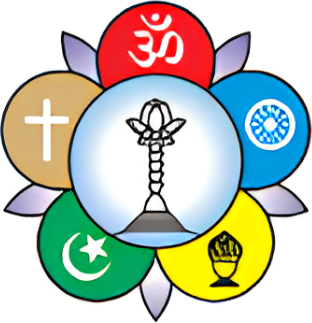
Sarva Dharma
Not a religious or proselytising organisation
The Organisation does not preach any particular religion, and no one is ever asked to follow a certain religion or ritual. Instead, each person is inspired to follow their own faith better, so that a Hindu becomes a better Hindu, a Muslim a better Muslim, a Christian a better Christian.
That is why the emblem of the Organisation is known as the ‘Sarva Dharma Logo’, which represents the unity of all faiths and progressions to spiritual realisation. It enshrines, in the five semicircles around the centre circle, the symbols of five major religions of the mankind.
Sources: ssssoindia.org/about-organisation, ssssoindia.org/insignias
Distinctive features
What sets it apart
Membership is free and entirely voluntary. Every distinctive feature flows from that simplicity.
Voluntary & spiritual
A totally voluntary service Organisation with a spiritual core and base.
Equality without discrimination
No distinction based on faith, caste, colour, creed or socio-economic status.
No fees or subscription
No fee, subscription or charge of any kind, by whatever name, for membership.
Self-transformation
The sole purpose of membership is one's own spiritual progress through self-transformation.
Unity of faiths
All faiths are equally valid; each member is helped to become a better follower of their own faith.
No fanaticism
No new cult or sect, only ‘Love all, Serve all’ and the Fatherhood of God and Brotherhood of Man.
No appeals for funds
No solicitation of funds; routine expenses are met voluntarily by members themselves.
Want to join?
About membership →
The Permanent Charter
The Divine Charter of 14 January 1981
Bhagawan Sri Sathya Sai Baba granted the Permanent Charter to the Sri Sathya Sai Seva Organisations at the Third World Conference on 14 January 1981. The Organisation is still governed by this Charter and by the rules in force from time to time.
In the Charter's words, the most fundamental object of the Organisation is to “Awaken in Man the awareness of the Divinity INHERENT in him”, by propagating through practice and example the basic principles of Sathya (Truth), Dharma (Righteousness), Shanti (Peace), Prema (Love) and Ahimsa (Nonviolence).
Source: ssssoindia.org/our-charter
Genesis
Since the 1960s
The seeds of the Organisation were sown in the 1960s: first bhajan centres and service Samithis, then, through a series of All India Conferences, the Sevadal, the Mahila wing and Bal Vikas. Over time that seed grew into a banyan tree whose branches now reach almost every district of the country.
Source: ssssoindia.org/genesis
Three wings
Spiritual, Education and Service
All the Organisation's work runs through three wings, and all three function under the Samithi.

Structure
From the nation to the Bhajan Mandali
The Organisation works at five levels. The Samithi and the Bhajan Mandali are its primary units, where members are bound by the dictum ‘Love all, Serve all’.
National
All India President · National Coordinators for each wing
State: Madhya Pradesh
State President · State Coordinators for each wing
District
District President · District Coordinators for each wing
30organisational districts
Samithi
Samithi Convenor · Samithi Coordinators for each wing
148Samithis
Bhajan Mandali
Bhajan Mandali In-charge
218Bhajan Mandalis
Structure: ssssoindia.org/units-and-their-functioning. Madhya Pradesh figures: state office records as of 27 September 2026.
As of 27 September 2026
Madhya Pradesh at a glance
- Organisational districts
- 30
- Samithis
- 148
- Bhajan Mandalis
- 218
- Approved members
- 22,638
- Sevadal
- 15,781
Source: state office records as of 27 September 2026. Every figure is from the record; nothing is estimated.

Go further
Code of Conduct, membership and office bearers
The discipline members live by, who can join, and how responsibility is shared across Madhya Pradesh.
Find a Samithi near you
Bhajans, Bal Vikas and seva in every organisational district of Madhya Pradesh.